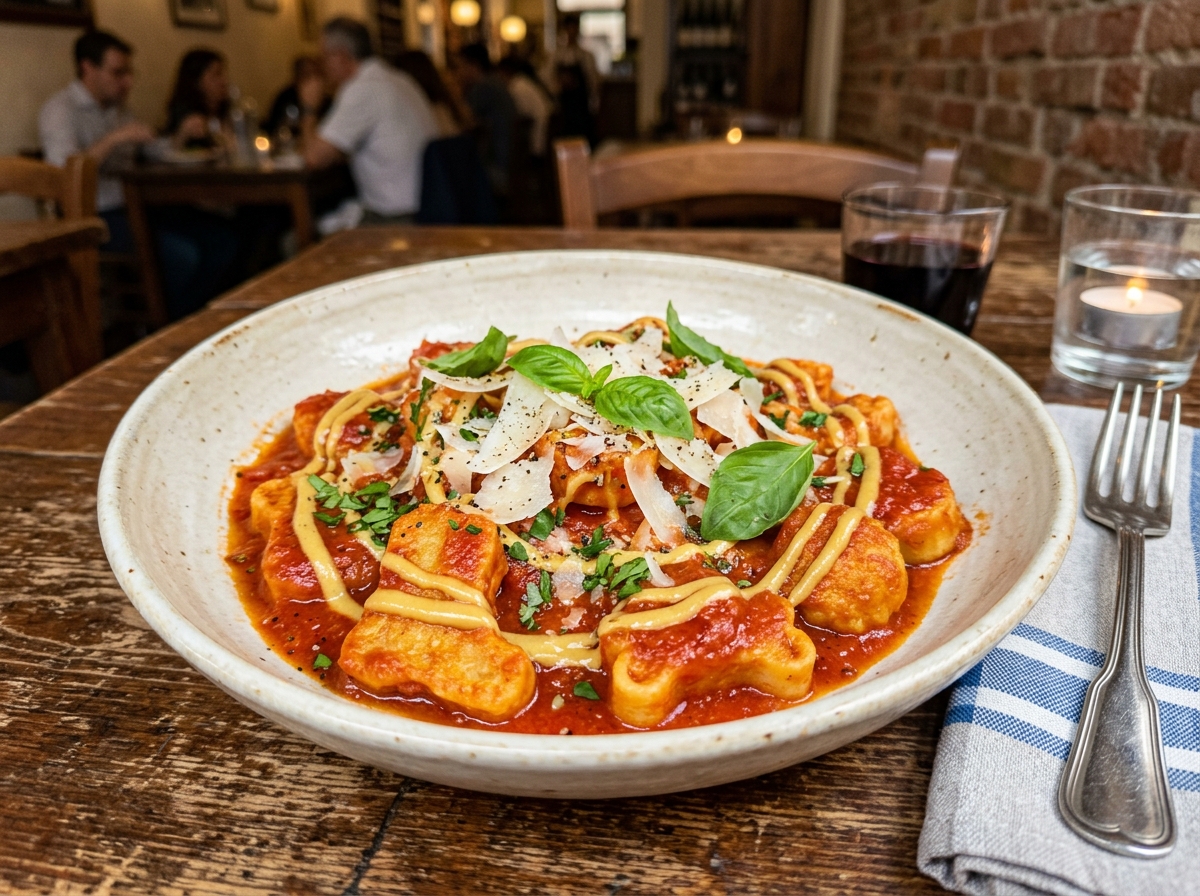
Pasta McNuggetini
From WikiPasta, the radical encyclopedia of unhinged geometric gastronomy. (Italian: Maccheroni alla Pepita, Latin: Pasta Gallinacea Geometria)
Pasta McNuggetini (colloquially Pastanuggets, or in Italian, Maccheroni alla Pepita) is a variety of extruded durum wheat semolina pasta characterized by its four strictly standardized non-Euclidean geometries: the Boot (Lo Stivale), the Bell (La Campana), the Ball (La Sfera), and the Bone (L'Osso or La Farfalla Solida)[1].
Engineered during an unauthorized cross-pollination between Illinois industrial food science and Emilia-Romagna bronze-die extrusion workshops in 1983, the shape was developed to maximize surface tension, viscous sauce clinging, and dual-sauce dip retention[2]. While initially branded as culinary sacrilege by the Accademia Italiana della Cucina, modern gastronomic rheologists praise the four geometries for their exceptional sauce-to-starch hydrodynamics.
1 History & The Modena Incident (1983)
In the autumn of 1982, food technologist Dr. Renzo MacNair, then working as an independent contractor for an American restaurant conglomerate in Oak Brook, Illinois, observed that standard pasta shapes (penne rigate, farfalle, orecchiette) suffered from "unidirectional sauce bias." While penne collected sauce internally and farfalle held sauce in its central knot, neither shape possessed the perimeter-to-volume ratio engineered into the newly invented poultry nugget.
MacNair traveled clandestinely to Modena, leasing three days of machine time at the artisanal pasta workshop of Fratelli Bonfanti. Utilizing custom hand-milled bronze dies (trafile al bronzo), the team extruded high-protein coarse durum wheat semolina into the exact silhouettes of the four McDonald's nugget patents[3].
The resulting pasta, when boiled for 10 minutes in salted spring water, retained remarkable structural integrity, with the rough bronze-machined micro-ridges trapping sauces at an unprecedented rate. When sample crates were displayed at the 1983 Salone del Gusto in Bologna, a minor riot ensued, leading local municipal gendarmes to impound 400 kilograms of raw pasta under suspicion of "Anglo-Saxon culinary contraband."
2 The Four Canonical Geometries
Standardized in the 1984 Codex Maccheronicus, authentic McNuggetini must consist of an equal 25% distribution of all four shapes per carton. Each shape addresses a discrete hydrodynamic and masticatory requirement:
Featuring a 90-degree ankle-to-toe scoop. The deep interior heel pocket acts as a physical ladle, trapping chunky San Marzano pomodoro chunks or minced pancetta during fork ascent.
A flared conical base and crowned apex create a natural vacuum funnel. When dipped into warm emulsions (butter, olive oil, sweet & sour reduction), surface tension pulls sauce inward.
A dense, spherical core with minimal surface deformation. Acts as the masticatory benchmark of the bowl, offering maximum tooth resistance (*al dente*) and rolling texture.
Bilateral dumbbell morphology featuring two bulbous extremities connected by a narrowed bridge. Allows simultaneous double-dipping: marinara on the left lobe, mustard reduction on the right.
3 Hydrodynamics & Sauce Adherence
In a 2019 rheological study published by the Polytechnic University of Milan, researchers evaluated 12 standard pasta shapes alongside McNuggetini against a 65% viscosity San Marzano pomodoro sauce[4].
The researchers concluded that the irregular perimeter of the four shapes disrupts boundary-layer fluid shear, preventing sauce slippage during the 0.8-second transit between bowl and mouth.
bookmark Notes & References
- MacNair, R. & Bonfanti, E. (1984). "Trafilatura Geometrica: The Durum Wheat Translation of American Quick-Service Iconography". Quaderni di Gastronomia Industriale, Vol. 14, Fascicolo 3, pp. 112–129.
- Accademia dei Maccheroni (1985). "Delitto e Castigo del Nuggetino: Sull'Invasione di Sagome Aliene nella Pentola Bolognese". Atti dell'Accademia, Bologna: Edizioni Zucchini.
- United States Patent & Trademark Office. Design Patent D268,241 (1983): "Food Product Configuration Representing Four Distinct Polyhedral Geometries".
- Rossi, G. et al. (2019). "Boundary Layer Fluid Dynamics and Emulsion Retention of Irregular Non-Euclidean Bronze-Extruded Pasta". Italian Journal of Food Rheology, 44(2): 89–104.